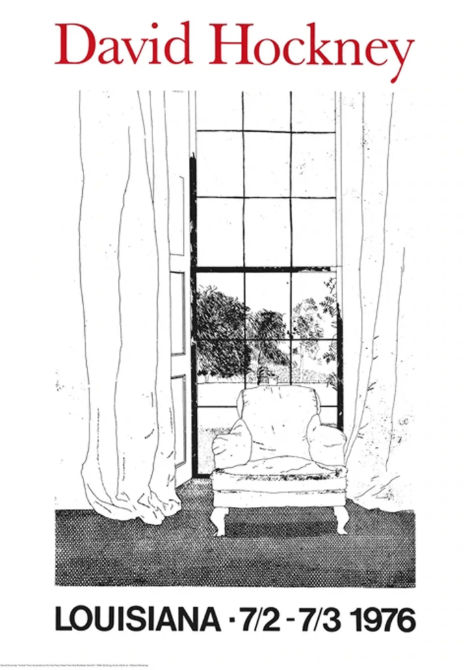
-
Hockney's work occupies a rare position in British art. It is intellectually ambitious without becoming remote; technically inventive without losing its human warmth. His great subject was often the visible world - faces, rooms, pools, flowers, landscapes - but his real concern was perception itself. How do we see? How does memory alter an image? How can flatness suggest depth, or colour create space?David Hockney’s work has always found intensity in the everyday. His subjects are often familiar - pools, flowers, portraits, interiors, landscapes - but in Hockney’s hands they become charged with colour, intelligence and life. His importance is not only that he is one of Britain’s greatest artists, but that his work continues to make people look harder, longer and with more pleasure.
For us, Hockney has never been simply a name of the moment. Chris, our founder, is from Bradford, as Hockney was, and that connection has always given his work a particular resonance. From the very beginning, we have offered and recommended Hockney’s work because of its significance, its collectability and its enduring ability to connect with people.
Printmaking was central to that achievement. Hockney studied at the Royal College of Art in London, where his early engagement with print was, in part, practical. The print department gave him access to materials at a time when money was limited. Yet what began out of necessity became one of the most important graphic practices of any British artist of the twentieth century. Hockney understood print not as a lesser form, but as a field of possibility. Etching, aquatint, lithography, photocopy and photographic collage all became ways of testing how images behave.
Read on to take a wander through Hockney’s eight-decade career, reflecting on some of the most inventive editions in modern printmaking.
-

-
-
-
-
-
These works trace something essential about Hockney. He was never fixed by medium, style or reputation. He could move from etching to lithography, from photo-collage to stage design, from photocopier to iPad, without losing the thread of his own vision. That thread was drawing. Not drawing in the narrow sense, but drawing as a way of thinking, observing and ordering the world.
Browse the full collection below, and email hello@hiddengallery.co.uk for more information.
-
-
David Hockney: A Life in Colour
Current viewing_room